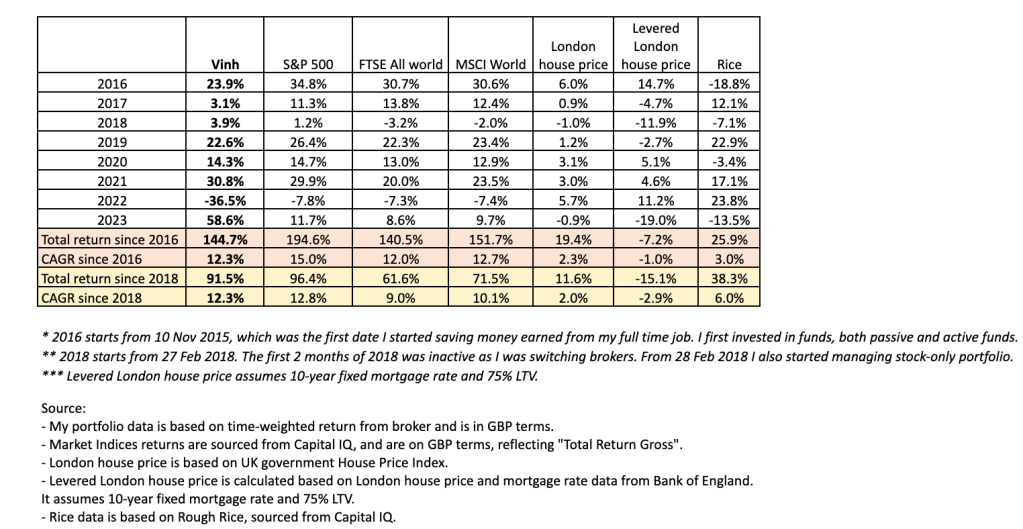
General section:
I’m now using a discount rate of 8-9%, at the time when the 10-year bond yield is currently around 4-5%. I also adjust my terminal growth rate to 2.5% from 2.0% to reflect the current inflationary environment. Inverse this I’m effectively putting an exit multiple of around 18x, and this also implies that I am currently looking for a purchase multiple of 11-12x normalized earnings (inverse of 8-9%), which also means that I am not paying anything for growth. I believe that being disciplined about this should lead to outperformance over the long term.
Company updates:
Meta is showing how generative AI can be used to boost engagement on social media platforms.
The advances in the Quest 3 VR headset also give me confidence in the current state of affordable AR/VR technology.
Over time, investors should adjust their normalized earnings estimates for Meta to view Reality Lab as an effective VC/R&D bet with a non-negative NPV at worst.
This could lead to a re-rating of Meta’s Core-apps profit from 15x normalized earnings to 18x, with the rest of the return coming from low teens earning growth.
I expect the existing social media advertising business to continue to grow at a low teens rate for the next 5-10 years, with AI turbocharging that growth.
Amazon is currently trading at around 18x normalized earnings. I value Amazon on a sum-of-the-parts (SOTP) basis, with an annualized run rate earning power of about $60-70 billion post-tax. This means that owning Amazon implies that I believe this earning power can double to $120-140 billion post-tax over the next 3-5 years. This could be enabled by the continued shift from offline to online retail, the cloud tailwind turbocharged by generative AI, and growth from the small(er) base of Amazon retail advertising.
Hotel Chocolat has now become the third largest position in my portfolio. My thesis on Hotel Chocolat is simple: the market overpaid for growth expectations in the US and Japan, which did not materialize on the timeline investors expected. This has led to negative sentiment around the stock, pushing it down to below 10x normalized earnings for the UK operation (based on revenue of £220 million and a pre-tax margin of 10%).
At its lowest point, Hotel Chocolat traded at 7x normalized UK earnings, and my cost basis is 8.5x normalized UK earnings.
In my view, the UK operation has the widest moat among the premium chocolate gifting market in the UK. Despite Hotel Chocolat’s market share of less than 1% of the overall chocolate market, I estimate that they have a 30-50% market share in the premium chocolate segment within the gifting seasons in the UK. This means that when consumers decide to trade up to a premium chocolate gift, they are more than 30-50% likely to purchase Hotel Chocolat than something else. The “something else” consists of many small players, none of which has more than $20 million in revenue based on my research. This gives Hotel Chocolat a moat that is as wide as Meta’s in social media.
Brookfield Corp has been the biggest headache in my portfolio going into this quarter. I initially considered selling my position, but after their investor day presentation, I have changed my view. The market is currently pricing Brookfield’s stock at $31 per share, which is 50% below Brookfield’s internal valuation of $70 per share. This is likely due to two concerns:
- Commercial real estate (CRE) concerns: The market is concerned that the value of CRE on Brookfield’s balance sheet (e.g., Canary Wharf) could be overstated, and that this could have a negative impact on the value of the rest of Brookfield’s real estate AUM (e.g., Brookfield Strategic Real Estate Fund).
- Renewable energy pricing: Renewable energy pricing is becoming very tight, with most funds in the UK trading below NAV because these funds have been investing in operational renewable projects at discount rates around 4-5%. This is clearly a poor return now that T-bills are yielding 4.5%. As a read across This means that Brookfield’s renewable AUM could also be overstated.
However, I believe that these concerns are overblown.
On CRE, while it is true that most of the value of Brookfield’s CRE now resides in the terminal value (i.e., upon an eventual sale of the property), this does not mean that the real estate is worthless atm. In fact, even at a conservative 2% rental growth rate, investors can expect a total return of 11% (5% from annual equity return + 6% of capital appreciation), assuming 6% NOI yield, 6% interest cost and 70% LTV. And if the Class A office owned by Brookfield is indeed Class A, then the total return upon an eventual sale could be much larger than 11% thanks to higher than 2% annual rental growth rate.
On renewables, I am convinced that Brookfield is not investing in operational renewable projects, which is where the pricing is very tight. Instead, they are developing projects from scratch (i.e., acquiring the lease, securing connection to the grid, getting the PPA, etc.). The return here, especially for more technically challenging projects like offshore wind platforms, can be much higher.
Book recommendation
I recommend the latest Elon Musk biography written by Walter Issacson. I bought the audiobook version of it and listened on 1.5x speed, and I actually became quite fascinated by his life overall.
3 things I admire about Elon:
- He has the just do it mentality instead of talking just the talk.
- He rose above his early life struggle, with non-loving relationship with his father, which is not the easiest hand to be dealt with.
- He built a culture of hardcore engineering which I indeed came to admire a lot in the companies I own shares in.
 One idea at a time